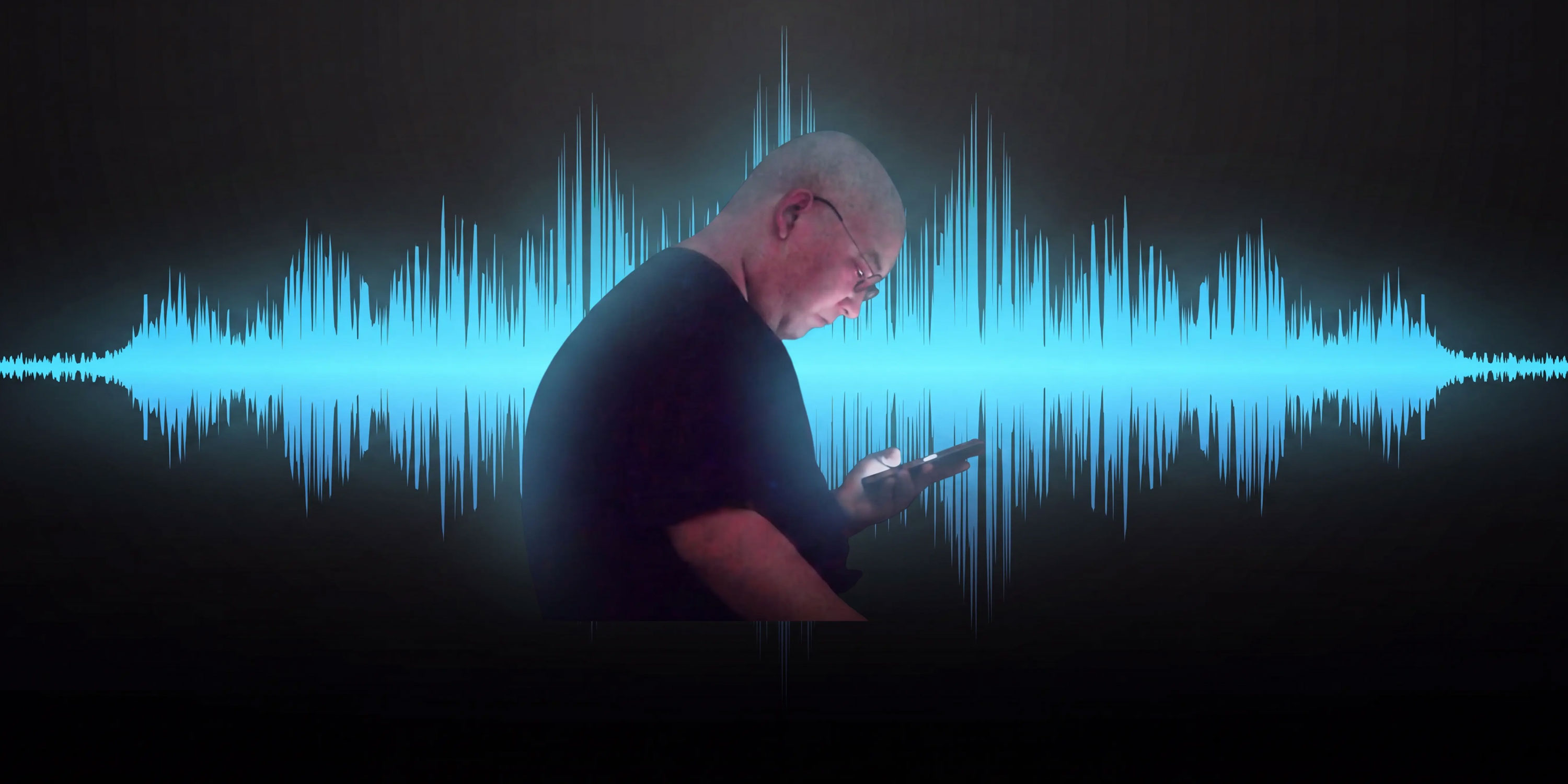
The Chinese Voice Actor Forced to Prove He’s Human
JIANGSU, East China — “Hello, sir or madam. I’m not AI — I’m a real voice actor. Now let me show you a tongue twister …”
Pausing for breath, Shen Anyu continues in a deep, resonant voice: “Ba bai biao bing ben bei po ...” He finishes and lets out a rueful smile. “How ridiculous this is.”
For the fifth time in the past year, Shen was recording a video to prove he was human.
Since 2025, AI copies of Shen’s voice have spread so widely online that platforms have begun flagging his real recordings as synthetic. For his clients, a mistaken label can mean fewer recommendations, fewer views, and less income.
The 31-year-old hears what sounds like his voice narrating movie explainers he never recorded, reading sports news, promoting products, peddling conspiracy theories, and even swearing in short videos circulating online.
Friends and relatives send him the clips, congratulating him — and sometimes asking to borrow money — assuming the flood of new work has made him rich.
It hasn’t.
Instead, Shen and his wife, Wei Yiyuan, now spend much of their time documenting the copies. They collect videos and screenshots, upload records, contact uploaders, file platform complaints, consult lawyers, and prepare for legal action. “There are simply too many of them,” Wei says.
As AI voice-cloning tools spread online, performers in China’s ultrashort-drama, audiobook, and short-video industries are encountering the same problem in different forms.
Some say they’ve found their voices in projects they never worked on. Others allege their voices have been sold as AI packages, built into editing apps, or used by clients to generate recordings without hiring them again.
Stopping the copies is harder still: Their creators are difficult to trace, platform complaints rarely succeed, and legal action can cost more than he is likely to recover. Worse, the more widely Shen’s cloned voice circulates, the more often he has to prove that his own recordings are real.
But long before he became trapped in this Kafkaesque spiral, Shen had spent years turning his voice into a career.
Muscle memory
Growing up in Xuzhou, in the eastern Jiangsu province, frequent illness kept Shen in bed for long stretches, and he spent countless hours playing video games and watching anime. But he was always drawn to the voices behind the characters, which gave each one a distinct personality.
By the time he was 20, Shen had moved between several jobs, including e-commerce customer service, where he endured angry customers and strict rules that even limited his bathroom breaks. With meager and unstable income, he relied on his parents’ savings to get by for several years.
“When I was younger, people would often compliment me on my voice,” Shen says. But it was not until six years ago, when a cousin asked him to narrate a science explainer video, that he began to see voice work as a career. More gigs quickly followed.
Since then, Shen has been the main narrator for a film-focused channel on Douyin, China’s version of TikTok, that has more than 5 million followers. Some of the videos he voiced have attracted millions of views.
He trained hard, listening back to his recordings and working on diction, emotion, and dramatic tension. Facial paralysis made plosive consonants — sounds such as “b” and “p,” which also dominate the well-known tongue twister above — especially difficult.
“I would exaggerate the facial effort, almost to the point of making intentionally intense or contorted expressions,” Shen says. “It was about training control over the facial muscles on the affected side, especially the parts that felt frozen or less responsive.”
With practice, the movements became muscle memory.
As a freelancer, Shen stayed on call around the clock, recording late at night, through fevers, and even while sick with COVID-19. Once, when he and Wei, then his girlfriend, were on their way to a romantic dinner, a job came in, and they turned around immediately.
When Sixth Tone visited his apartment in Xuzhou in June, Shen had just woken after finishing an urgent recording at 3 a.m. Soon after, the client messaged again, asking for a take with stronger emotion. Shen returned to his seat, adjusted his hoarse morning voice, and began recording.
Shen’s monthly income eventually reached around 10,000 yuan ($1,500), rising to 30,000 yuan in busy months. Last year, he married Wei, and the couple moved into a newly renovated home.
“All of this was only possible because of my voiceover job,” Shen says.
The first warning came in 2023, when a friend sent him a four-minute video introducing a Chinese actress in a voice that sounded like his. Shen was furious, but not yet alarmed: The AI version was still crude, with awkward pauses and unnatural pronunciation. Some fellow voice actors thought he was overreacting.
But the copies improved quickly. Shen began finding AI versions of his voice that sounded more natural — close enough that even his parents and friends struggled to tell the difference. Some AI voice models could generate close imitations from only seconds of recorded speech, reproducing elements of a speaker’s tone, rhythm, and emotion.
Then the bookings began to fall.
By 2024, former collaborators stopped hiring him and turned to AI-generated voices instead. Others offered to use an AI version of his voice at a much lower rate.
In one livestream, a presenter demonstrated an app that could generate voiceovers from text in a few clicks. Using a demo voice that sounded strikingly similar to his, the presenter turned a script into a movie explainer narration and told viewers, “For the price of a bottle of mineral water, you can generate voiceovers for several movie explainers.”
For Shen, recording the same amount of material would have taken more than two days.
What troubled him most was how easily the product of that labor could be separated from the person who created it. “We used to believe that meaningful results required learning and effort,” he says. “But now everything can be achieved in an instant.”
As the jobs declined, the life Shen and Wei had built around his voice began to feel less secure. Their income no longer covered their living costs, and Shen expected it to keep shrinking.
“All the experience and practice can simply be copied and reused at will,” Shen says. “To me, that erases the person behind all that work.”
Copy machine
Before his voice was cloned, Shen had found himself increasingly confined to a single, repeatable style.
After a series of videos Shen voiced went viral, clients began asking him to reproduce the same delivery and emotional tone, a standardized style that recommendation algorithms had already rewarded.
“I could offer different emotions or interpret the lines in other ways, but that wasn’t what they were looking for,” he says. “If I changed my delivery, they would immediately tell me it wasn’t the style they wanted.”
To keep working, Shen repeated that performance until it became his “standard” voice online. “Many people simply extracted the audio from that viral video and used it to train an AI voice clone.”
Shen still does not know who first cloned him. But he has found sellers offering what sounds like his voice in downloadable packages, as well as editing apps that allow users to select it and generate new recordings.
For Ciya Liu, 28, suspicions that her voice had been copied began with a routine rerecording request.
Days after she submitted her recordings for the female lead in a recent ultrashort drama, the production company sent back several clips and asked her to rerecord them for better quality. The voice sounded like hers, down to small flaws in her pronunciation. But the pauses and stresses were not choices she recognized.
“Could this be my voice?” she recalls thinking. A friend listened and agreed that it sounded unmistakably like her.
Liu believes the company generated the clips from her recordings without her knowledge. When she confronted the company, it denied training an AI system on her voice but could not explain where the clips had come from.
Her suspicions deepened when the company later told other freelance dubbers to accept a 10% pay cut or face delayed payment. It also indicated that this would be their final collaboration, as they were shifting to AI-produced ultrashort dramas.
Such productions often rely on stock characters with highly specific vocal types, from domineering executives to innocent young heroines. When actors’ natural voices do not fit those roles, producers hire dubbers like Liu or Shen.
China has only several hundred established professional dubbers, but industry estimates put the wider pool of voice workers in the hundreds of thousands, serving an audio-content market with more than 740 million users and an ultrashort-drama audience of over 660 million.
As those industries expanded, companies raced to produce more content at lower cost. Voice actors interviewed by Sixth Tone said both rates and the number of available jobs had fallen.
Xu Ziqi, a 30-year-old voice actress, says audiobook jobs that once paid at least 80 yuan an hour now attract applicants willing to work for half. Groups on the messaging app WeChat that once carried dozens of assignments a day may now go several days with only a handful.
Earlier this year, dozens of established voice actors publicly stated that they had never authorized their voices for AI cloning. 729 Voice, a leading Chinese voice-acting studio, said AI-generated dramas were appearing across thousands of episodes and countless accounts, making unauthorized uses nearly impossible to track.
Xu, who mainly dubs animations and ultrashort dramas, sees little security in getting better at the work.
“Many newcomers believe that if they refine their voices and improve their skills, they can rise above AI,” she says. “But those of us who have worked in the industry for years know that clients often want only a particular vocal timbre. Now AI can reproduce any timbre they want.”
Xu began as an audiobook narrator, then moved into ultrashort dramas as AI began to displace human narration. Now the same shift is reaching dubbing. Despite her rising income, she is considering leaving the industry.
“AI takes the best voices and performances from everyone,” she says. “The more skilled you become, the more material it has to learn from.”
Proof of life
By 2025, Shen’s AI clones had become convincing enough to cast doubt on his real voice. When platforms flagged his recordings as AI-generated, the videos could be excluded from recommendation feeds, cutting views and earnings.
When one of his clients contacted a short-video platform after one such flag, an agent assumed Shen’s studio did not employ human voice actors.
“He is a voice actor working for our studio,” the client told the platform’s agent. “His voice has been illegally cloned using AI and is now being used everywhere.”
The agent apologized, saying, “I had no idea. I’ve heard that voice so many times that I just assumed it was AI-generated.”
Around then, Shen began recording videos to prove that the voice belonged to a real person. He also contacted uploaders directly, explaining that they were using his voice without consent.
A few removed their videos; most ignored him. Others responded with abuse.
“Don’t mess with me,” one wrote. “I’ll use another voice, make even better videos, and crush you under my feet.” Some offered instead to buy the cloned voice or pay for his authorization.
As the responses and sheer number of copies began to overwhelm Shen, Wei stepped in.
A former pharmaceutical sales representative, she had left her job while preparing for their wedding and to deal with family matters. As Shen’s voiceover work declined, she began editing videos for his short-video channel and helping document the unauthorized copies.
She listed each suspected infringement, copied the links one by one, and sent them to Shen, who then recorded the verification videos required by the platforms. Some accounts contained hundreds of clips.
“Sometimes he’d already be asleep, and I’d still be there hunting down videos and copying links,” she says. “I was just so angry.”
When one complaint finally succeeded, Wei thought they had found a way to fight back. “After that, I just started copying links like crazy,” she says.
But almost none of the other videos came down. “As we continued to collect evidence and file complaints, we became more desperate every day,” Wei says.
With the platform complaints going nowhere, Shen took the fight to court. But before the first hearing could begin on July 2, the defendant sought to transfer the case to a court in another city.
To succeed, he would first need to establish a clear chain of evidence showing that the synthetic voice was derived from his recordings. That could require forensic voice analysis costing at least 10,000 yuan, according to lawyers interviewed by Sixth Tone.
Identifying whom to sue presents another problem. The people who created the clones are often impossible to trace, while the accounts publishing them are too numerous to pursue individually. Many of those accounts earn little from the videos, meaning that even a successful case might yield only modest damages.
Ren Xiangyu, a lawyer based in Beijing, tells Sixth Tone that imbalance is becoming common. Before AI cloning, voice infringement cases were rare because reproducing someone’s voice was technically difficult. Now, the technology has made imitation cheap, fast, and widespread.
Ren represented the plaintiff in China’s first AI voice-infringement case, decided in 2024 and later selected by the Supreme People’s Court — the country’s highest court — as a reference case.
The ruling treated unauthorized voice cloning as a violation of personality rights rather than copyright, making clear that owning the copyright to a recording does not give a company the right to reuse the performer’s voice for other purposes.
But cases like Shen’s are harder to untangle. Ren’s client had more than 50 hours of audiobook recordings and a clearly identifiable defendant. Today, uploaders can take a three-second clip, generate a 10-minute voiceover, and distribute it through countless accounts.
“The consequences of infringement are too low,” Ren says.
Ren says litigation alone cannot keep pace with the technology. Performers still have no effective, accessible way to prevent their recordings from being scraped and used to clone their voices.
The greatest strain on Shen and Wei’s marriage has been financial. As Shen’s voiceover work has declined, each lost job has deepened his anxiety and affected Wei in turn. “It’s like a constant backdrop to our lives,” she says.
In recent months, Shen has struggled to sleep and has begun smoking more, despite knowing it could damage the voice he depends on.
“Every time I hear the AI version, I go through the same cycle,” he says. “First fury, then helplessness, and finally disappointment.”
Wei compares it to “punching into cotton — no matter how hard you punch, it has no effect.”
Some people urged Shen to authorize his own clone and profit from it. Other voice actors who have lost work have begun teaching AI-cloning techniques themselves.
But Shen refuses. “I don’t think AI is a bad thing. It’s a tool,” he says. “But how people use it is the problem.”
After sharing his experience online, Shen began hearing from voice actors and workers in other industries facing similar problems. Their messages strengthened his resolve, and he began devoting more of his time to documenting unauthorized uses of his voice and preparing his case.
“This is how I make a living,” he says. “If I don’t fight for it, no one will fight for me.”
Shen expects the case to be difficult. “I may be dealing with this for years, perhaps for the rest of my life,” he says. “I’m prepared to lose, but I hope it can at least change something.”
To replace some of the lost income, Shen and Wei have begun producing short videos of their own. Posts sharing his experiences and views on AI attract the most attention, but Shen’s favorite is one he made about Xin Qiji, the 12th-century Chinese military commander and poet whose works brim with his unfulfilled ambitions.
Shen says he was drawn to Xin’s turbulent life and the quiet sorrow running through his verse. As he recorded the script, he found himself pouring his own feelings into the lines.
For those few minutes at the microphone, he was speaking on his own terms.
Additional reporting: Lü Xiao; editor: Apurva.
(Header image: Visuals from VCG and Lü Xiao, reedited by Sixth Tone)